
There’s a unique sense of intrigue that surrounds every new Fumito Ueda project. Familiar, yet exciting. A promise of a connection between character and player that few others can forge. But the Ico, Shadow of the Colossus, and The Last Guardian creator is moving away from his fantasy worlds with Gen Atlas, shifting to a land of sci-fi where giant robots lie strewn across its shores, waiting to be awoken. That quiet image of towering metal creatures served as the spark for this new project.
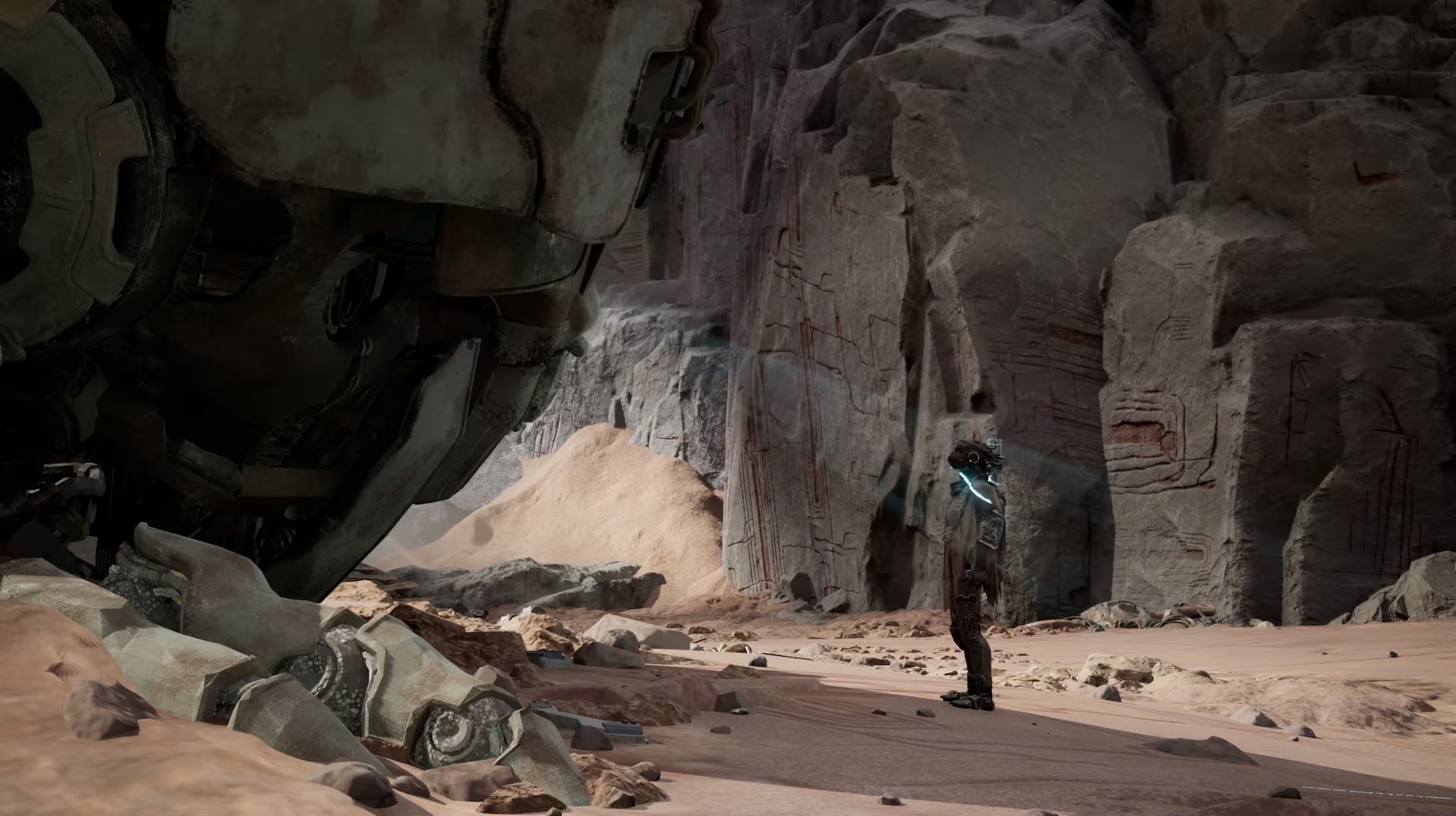
“I knew I wanted to feature giant robots in the game,” Ueda told me in an interview at last week’s Summer Game Fest. “But the slightly longer answer is that there was an image in my head that really stuck, and I couldn’t let go of that visual that I had. The robot’s head is detached, and it’s carrying its own head underneath the arm. I knew that I wanted that somehow to be in the game, and then it kind of expanded from that.”
What exactly we’ll be doing with these titanium torsos and steel skulls remains much of a mystery. But after viewing the extended version of Gen Atlas’ SGF trailer, which showcases a little extra gameplay, I can make some inferences. It seems to me as if it’s an evolution of The Last Guardian’s companion concept, just with one huge difference: this time, the oversized companion itself will be controllable, as well as the human protagonist. Perhaps Ueda has taken on feedback from players that this is a desirable option that has never been the case in any of his games to date.
Combat will also feature more heavily – I saw rattling energy weapons fired at pursuing enemies, as well as an orbital strike that obliterated all those in the vicinity of its impact. It’s a conscious decision from Ueda, who admits to going from one extreme to another over the course of his works when it comes to action.
“So when you look back at my first game, with Ico, combat wasn’t really a main mechanic,” he says. “And then I do feel that there is a little bit of a, ‘Okay, let me shift to the other side of that, not extreme, but I’m going to change things up.’ As a result, in Shadow of the Colossus, there’s a higher degree of action, combat, and violence. Then I swung the opposite way again with The Last Guardian. So now, looking at Gen Atlas, maybe I’m going back to having a higher degree of combat.”
The switch to sci-fi opens up the option for such varied weaponry to exist, with simple sword slashes and stabs having been the limit of his previous dip into action. But don’t expect the change of scenery to signal a departure from the themes that Ueda’s games have commonly touched on — humans’ connection with nature, discovering the stories of a new world, and unexpected bonds formed through isolation.
“Thematically, I don’t think you’re going to see anything that different,” reveals Ueda. “Having said that, the way I’ve approached building my previous games is that every single time I start creating a world and what lives in it, the goal is that it doesn’t exist in reality, but it’s as if it does, and the layers that come on top of it make that work, right? It’s really grounded in the reality that is in that world, and so I would want for players to, at the end of the experience, remember it 10 years later, and ask themselves, ‘Does that world still exist? What is going on in that world? What if it did exist?’”
Famously, all of Ueda’s previous works have taken place in hauntingly quiet fantasy worlds. Centuries-old architecture is commonplace, regardless of if you’re thinking of Shadow of the Colossus’ temple or the sprawling castle of Ico. But shifting to a future setting meant rethinking how Ueda sold the “vibe” of his lonely lands.
“When we expanded this to become a sci-fi world, it did open up possibilities in the sense that there are things that I did not really approach or integrate in my previous world because they just didn’t fit or match that theme or that setting. For example, the main character and the robot are going to have communication, and because it’s in a sci-fi world, it’s very natural to keep a log of conversation, right? So there are definitely gains that I get from moving over to it being a non-fantasy and sci-fi world.”
Dialogue has never been prominent in Ueda’s work, with Shadow of the Colossus’ spoken words mostly limited to Wander’s cries of “Agro!” as he beckoned his mount, and The Last Guardian branching out slightly to command Trico around its perilous architecture. Human language has never played a part in these stories, but it sounds like Gen Atlas might be breaking new ground in this department. That remains to be seen, but what we do already know is the astonishing effect the director’s tales can have on those who play them, even when the power of words has been purposefully relinquished.
“I do think about leaving some kind of mark in people’s lives and their hearts,” Ueda admits. “But it could be a feeling of hurt, too. It’s not always going to be a happy thing, right?”
“But for me, I’m also not sure what that [mark] is. It’s not well defined, as in ‘I want people to feel sad.’ It’s told in a somewhat complex way, and I leave it up to the player to interpret how you’re feeling. I never say ‘This is a scene that you’re going to cry’ or ‘This is a scene that’s going to make me sad’, or I don’t have characters that are like, ‘Oh, the antagonist is going to make this into a very bad moment’. I’m not leading to a singular conclusion for you to feel this way. And so whatever the feeling is that is in you, and that stays with you, is what makes me happy. And as long as I’m hitting those notes, then I’m fully satisfied.”
Different people will interpret Ueda’s games in different ways, such is the intention of his art. But one universal feeling amongst those who play his games is that sense of awe — whether it be the first time you rode up to a colossus in 2005 or came face-to-face with a giant bird-dog called Trico in 2016. That certainly looks set to continue if Gen Atlas’s reveal trailer is anything to go by. Spectacle is littered across each and every frame. A sense of scale has always been something Ueda has attempted to convey, as part of his greater quest to establish human connection through even the most rudimentary of sensations: that “wow” feeling.
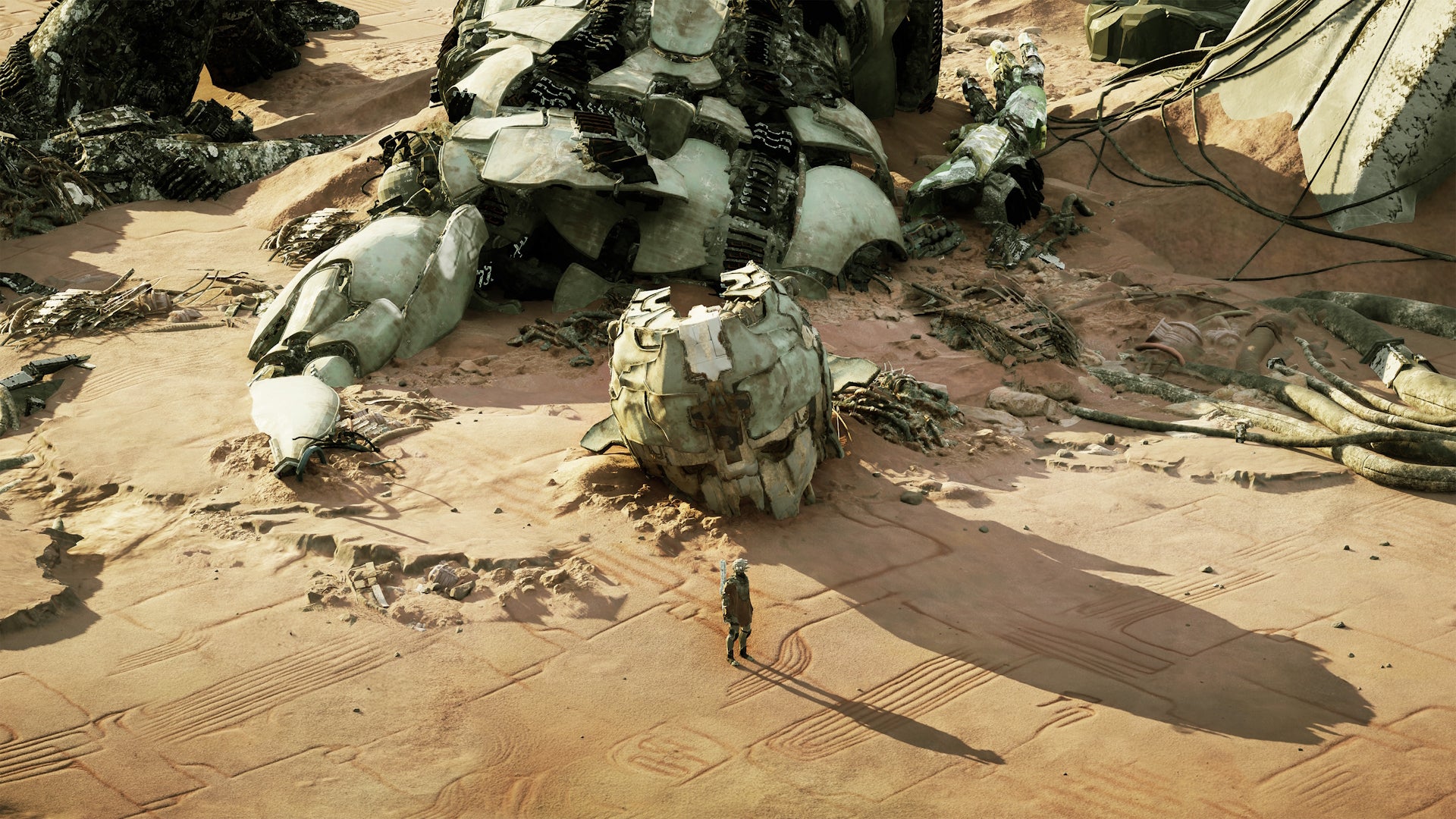
“I think a lot of us humans find something very appealing when we see something of grand scale,” explains Ueda. “Whether that’s robots, mechs, or creatures. For example, whales are gigantic. Why? There’s a sense of awe, right? Just looking at giant fireworks in the sky. I don’t know if you feel the same way, but there’s kind of a sense of wonder and awe that you get from something that is so big and larger in life, so to speak. And so I think that’s a more natural thing for any human to feel.”
There’s still so much left to know about Gen Atlas, but one thing we can be sure of is that each aspect of it will be designed with utmost intentionality. Ueda games are never rushed — he’s only given us three in 25 years, after all — but always worth the wait. There’s always that sense of anticipation. What will those initial feelings of wonder evolve into as the story reaches its final moments? Joy? Melancholy? Hope? We’ll likely all feel something different. For now, though, with no release date or window currently given, the wait will have to continue.
I had just one last question for Ueda before my time ran out. What does Gen Atlas mean? The answer, typically, could have many different meanings, depending on your interpretation.
“So ‘Gen’ has multiple possible meanings,” Ueda explained. “It’s the root of the words genesis, gene, generate, and generation. And then Atlas, I think a lot of people think about the world map, right? So it has a meaning of building the world. And then it is also the first cervical vertebra that connects the head and the neck.
“But in its totality, I was hoping that Gen Atlas, the combination of those two words, would give the image of something very grand and new that encompasses all these layers of meaning.”
We’ll just have to work out that meaning for ourselves when Gen Atlas arrives sometime in the future.
Simon Cardy is a Senior Editor at IGN who can mainly be found skulking around open world games, indulging in Korean cinema, or despairing at the state of Tottenham Hotspur and the New York Jets. Follow him on Bluesky at @cardy.bsky.social.