
While other EA Sports series like Madden, NHL, EA Sports FC are on a yearly release schedule, the UFC games have always benefited from the fact that EA Vancouver is able to take substantially more time in between each entry. In this case, it’s now been nearly three years since the release of UFC 5. And after a recent four-hour hands-on session, my first impression is that those three years feel well spent, as UFC 6 is shaping up to be another knockout for the franchise.
It was immediately clear to me once I picked up the controller that one of the pillars that EA Vancouver focused on with UFC 6 was making each fighter feel more distinct than they have in the past. No longer does every athlete have the same blocking stance. Instead, they have each been placed into one of four buckets that determines how their defense works. Elusive fighters, such as Anderson Silva, Dominick Cruz, and MVP, all use an evasive stance, which keeps their hands low even while they’re holding the block button. They can and still will block, of course, but with these fighters you’ll probably want to focus more on making use of their increased head movement and reduced vulnerability while they’re bobbing and weaving.
Those who keep their hands up and keep a strong guard employ the sturdy style of defense, where their block is enhanced, but they are far less mobile while keeping their hands up. Many fighters utilize a balanced style that keeps their hands up but doesn’t offer much in the way of significant advantages or disadvantages, and a few fighters, like Sean Strickland, make use of the Philly Shell, which has the unique perk of being able to mitigate both head and body at the same time, but is more vulnerable on the side of the head that is being undefended.
For casual or non-MMA fans, this probably won’t make too much of a difference, but as someone who prefers picking his favorite fighters and trying to emulate the way they fight in real life, I loved being able to pick a fighter like Dominick Cruz and then just be able to play in a way that is true to the way he used to fight – lots of darting in and out, tons of head movement to avoid shots, and a barrage of shots thrown from awkward angles.
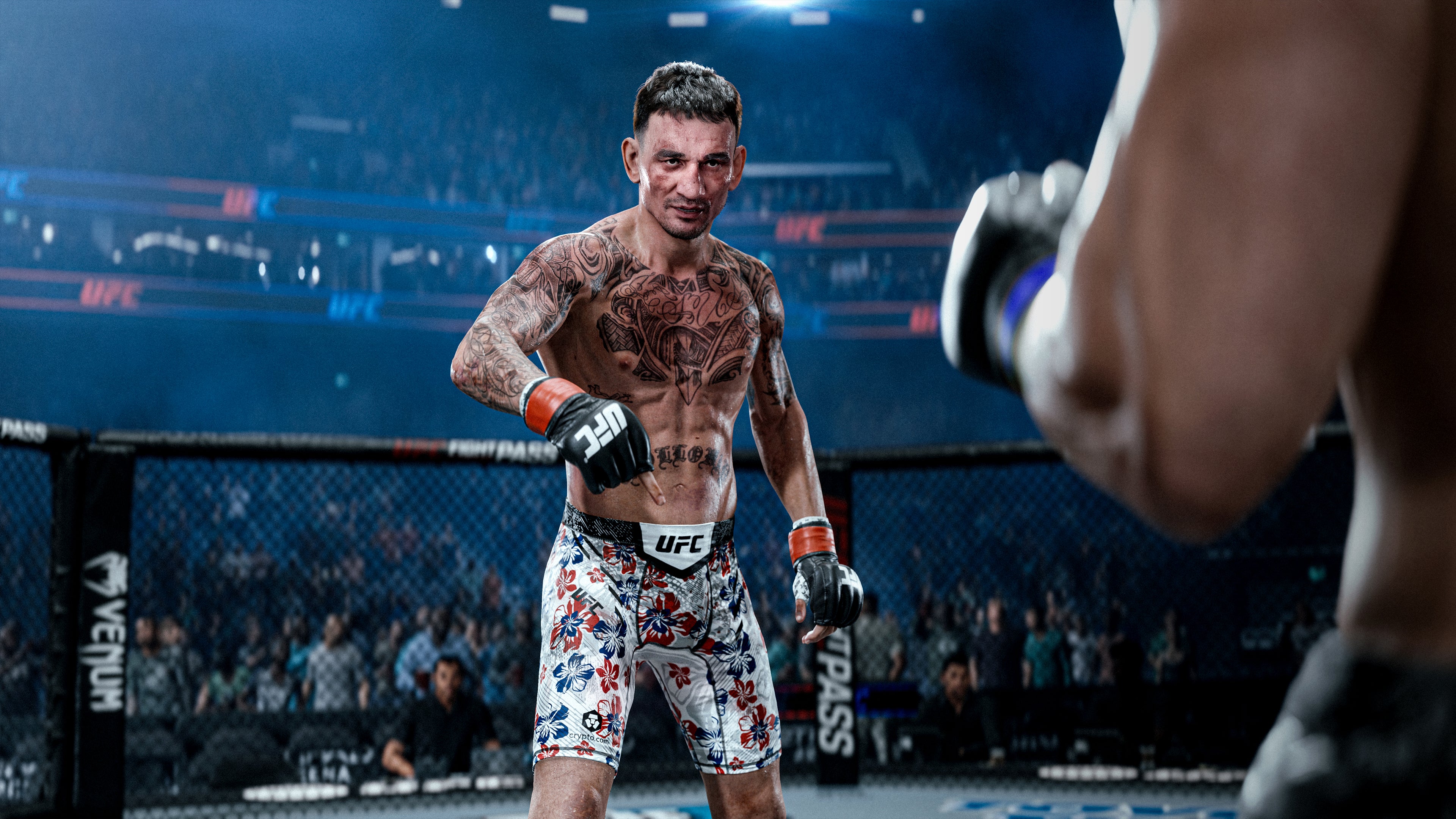
This push for fighter identity goes even further with the core new feature in UFC 6: Flow State. It’s basically a powerup that you can trigger once you fill up a meter that enhances a specific aspect of your fighter’s playstyle for a limited amount of time. So for example, Max Holloway’s Flow State enhances his advancing footwork and stamina efficiency, encouraging him to move forward and engage in potentially reckless offense. The cool thing about it, though, is that the opponent can respond to this with a taunt to earn a portion of the buff as well, encouraging them to also engage in potentially reckless offense. It’s a mechanic pulled directly from Max Holloway’s own signature style of closing out fights by pointing down at the ground and daring his opponent to go blow for blow against him right in the center of the octagon.
In order to build these Flow Meters, each fighter also has their own Flow Boosts, which award bonus meter gain for performing certain actions designed around emulating how that person would actually fight. So if you’re one of those aforementioned elusive fighters that utilizes a lot of head movement, chances are you might have the “Like Water” flow boost, which gives you a boost of Flow Meter whenever you successfully land a punch after slipping a punch. Those with a more ground-game centric fighting style benefit from Flow States too, with fighters like Islam Makhachev getting their Flow Boosts by attacking with a variety of submission techniques, and getting huge bonuses to their submission prowess when activating Flow State while on the ground.
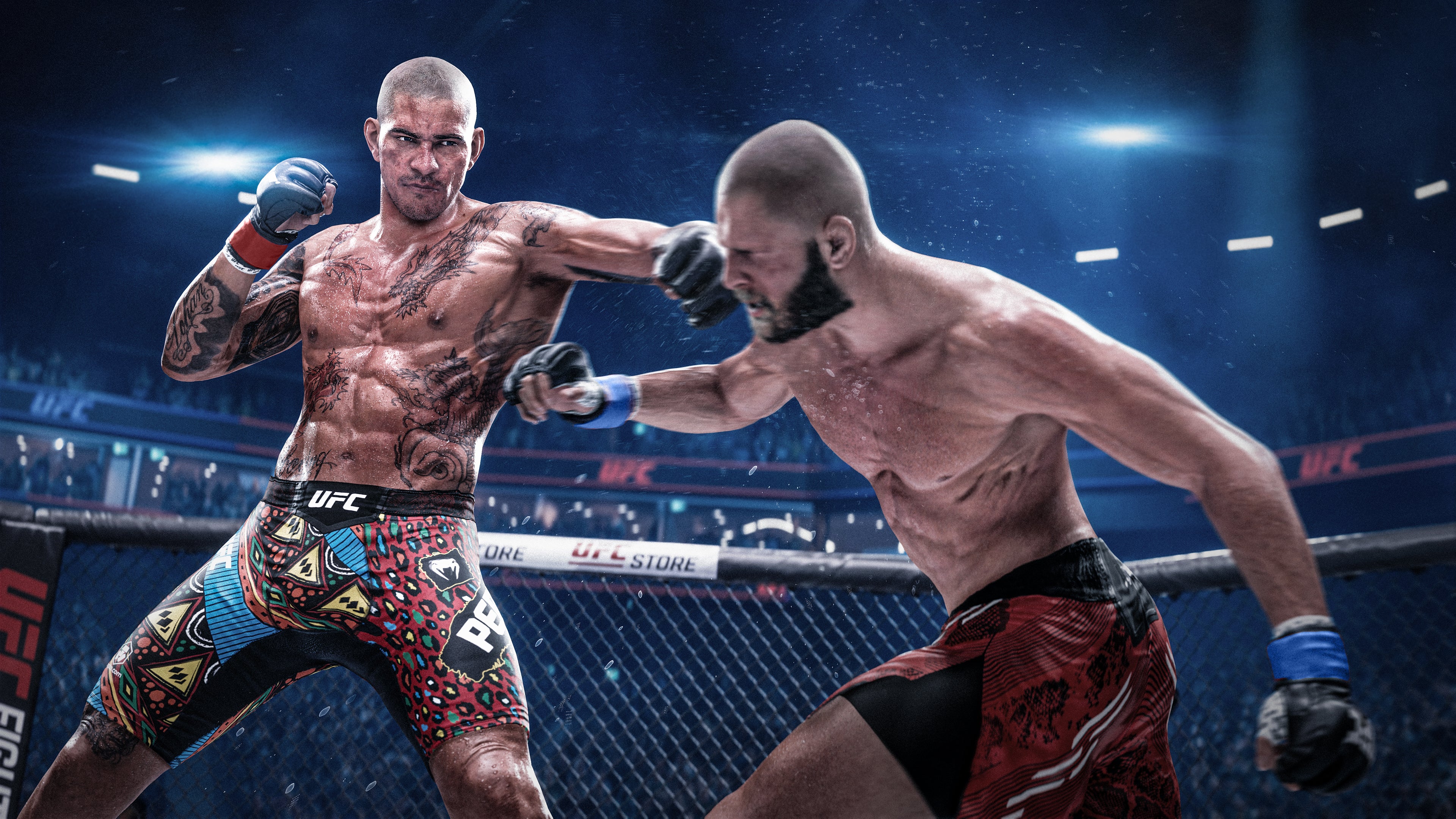
The Flow State system represents the biggest change to how UFC 6 plays compared to prior iterations, but there are a lot of smaller quality of life changes as well. More prominent hit effects make blows more impactful; the new physics system does a great job of making blows connect and deflect off blocks with more realism than before; there’s a new optional Time Dilation feature that slows down time and helps newer players understand when they should be blocking, swaying, or defending transitions on the ground; and my personal favorite is that fact that by default, jabs and straights are on two different buttons, regardless of what stance you’re in, so there’s no more accidentally throwing a slow straight when you meant to pepper in a couple of jabs, which has always been a personal sticking point for me with this series.
What Is a Legacy?
While the Career Mode itself has seen a number of adjustments, like making it faster to get to the UFC, a straight-up shop where you can buy new moves as opposed to having to learn them from UFC fighters, and a bunch of new choices that can lead to either positive or negative outcomes, the big change this time around is the fact that there is now a cinematic prologue chapter called “The Legacy.”
The Legacy puts you in the shoes of Chris Carter, a former collegiate wrestling standout looking to try his hand at MMA in an attempt to escape the shadow of his gold medal-winning father. His journey intersects with Danny Lopez, a similarly promising MMA upstart who is single-mindedly driven in his goal of becoming champion and proving his doubters wrong. Without going into spoilers, I’ll just say that while the two start as training buddies and good friends, eventually they become bitter rivals, with their hotly anticipated UFC showdown serving as the climax of the prologue, after which you naturally get funnelled into the traditional career mode.
In my hands-on time I got about two-thirds of the way through the story in just about two hours or so, and my overall impression was pretty positive. Like prior UFC career modes, it does a good job of teaching you the basics of UFC 6 while contextualizing them all as training sessions for an inexperienced MMA fighter, only this time that inexperienced MMA fighter is an actual character with a backstory and clearly defined motivations. The story itself is a simple one, and since it is designed to be just a short prologue chapter, not a lot of time is devoted to developing the actual relationship between Chris and Danny, but it nevertheless succeeds in giving these early pre-UFC fights meaning and makes them less arduous to get through, which is a big win for the Career Mode in general.
Welcome to the Hall of Legends
While Career Mode remains the thing that single players will put the majority of their time into, what I’m personally most excited about are the interactive museum-like exhibits that make up the Hall of Legends.

These are fully explorable hubs designed around the careers and cultures of three UFC fighters: Max Holloway, Weili Zhang, and Alex Pereira. Weili’s, for example, starts off by dropping you into a recreation of her hometown of Handan, China, where you can interact with several kiosks to read up on some background about how she started on her MMA journey, including clips of children training at the same martial arts school that she attended as a child, as well as insights into her personal life, like how her mother used to dig holes for her to jump out of, with each hole getting deeper and deeper, to the point where Weili herself described them as pits. It’s fascinating stuff!
I said before that these are like interactive museum exhibits, but there’s also an element of a Disneyland dark ride as well, with the way that scenes unfold and change as you walk through them. The swelling and prideful music that scores the Handan scene gives way to a hip hop beat as you enter the “China’s Champion” wing of the hub, which is themed like a UFC gym and focuses on Weili’s actual UFC career and her significance as the greatest Chinese fighter to ever step foot in the Octagon.
Of course, you won’t be just walking around, reading text logs and watching videos. Each wing comes with a defining fight in that person’s career that you can play through, complete with its own context-setting introduction. In most cases, you won’t play through the full fight, just the end, with optional clear conditions that reward you for staying true to how the actual fight played out.
As a longtime MMA fan, I loved everything about this mode. It humanizes the athletes; it’s a wonderful show of different cultures, done in a very respectable way; and it let me revisit some of my favorite fights in a way that only video games can allow. It’s a feature that I hope sticks, because I’d love to see similar treatment done for fighters like Anderson Silva, Khabib Nurmagomedov, Conor McGregor and Kamaru Usman, just to name a few.
One other really neat addition that I appreciated greatly as a fighting game fan is the fact that the training mode now has a Street Fighter 6-like frame meter that breaks down how fast each technique is down to the last frame. UFC 6 seems to be making a push towards being more like a fighting game thanks to its the more distinct styles of each fighter, special meters, and now, they’re even upping their training mode game.
Overall, UFC 6 is shaping up extremely well ahead of its June 19th release date (June 12 for Ultimate Pass owners). The improved lighting and fighter models make it look noticeably improved, the striking is more satisfying, there are far more distinct-feeling fighters thanks to the new Flow State mechanics, and the Hall of Legends is a true treat for UFC fans looking to relive classic moments of the sport as well as learn more about some of its most influential fighters.
Mitchell Saltzman is an editorial producer at IGN. You can find him on twitter @JurassicRabbit